Arizona's First African American Museum Opens at University of Arizona, Inspired by a Grandson's Question
The African American Museum of Southern Arizona, the state's first and only museum of its kind, began as a 7-year-old's school assignment and now sits in a single room at the University of Arizona's Student Union.
By Juan Gonzalez · · Originally reported by KJZZ
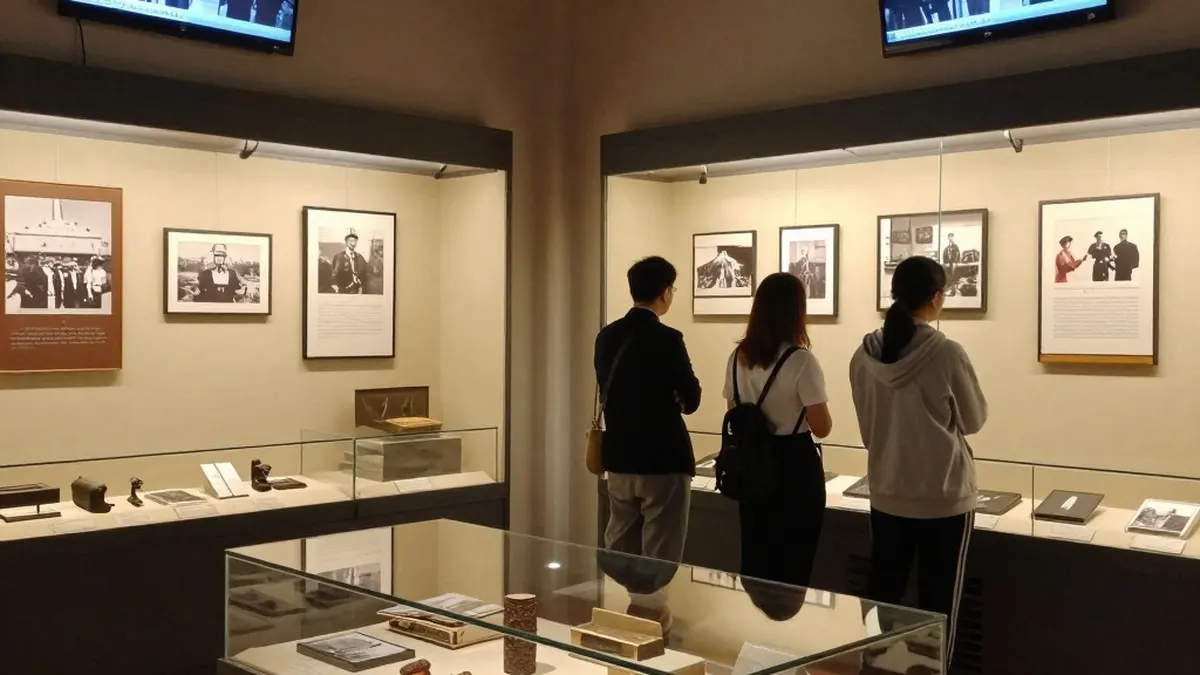
A little more than a month after it welcomed its first visitors, the African American Museum of Southern Arizona is settling into its home on the University of Arizona campus. It is the first and only African American museum in the state.
The museum formally opened in January with a ribbon-cutting that drew more than 300 people. Bob Elliott, its chairman and co-founder, says the project actually began two years earlier, in February 2021, with a Black History Month assignment given to his 7-year-old grandson, Jody.
The boy was asked to report on a hero or "she-ro" of his choosing. Searching online, he found the familiar names, among them Martin Luther King, Sojourner Truth and Harriet Tubman. Then he asked his grandmother, Beverely Elliott, where he could go to find a museum about people who look like him.
No such place existed. When Beverely explained that there was simply no museum, Jody told her, in Bob's retelling, "then you need to start one, and I'll help."
The Elliotts have long ties to both African American history and Arizona. Bob, who stands 6-foot-9, came to Tucson from Ann Arbor, Michigan, in the 1970s after being recruited to play basketball at the university. Beverely serves on the board of the African American Cultural and Historical Museum of Washtenaw County in Ann Arbor. Part of what drew Bob to Arizona in 1973 was the hiring, a year earlier, of Fred Snowden, who became the first Black head basketball coach at a major Division I college in the United States.
The museum is a simple single room in the Student Union. Glass cases tell stories such as that of Margaret Campbell, Arizona's first African American novelist, who spent years living in an underground home in Tucson before her death in 1971. Wall-mounted screens play interviews, some recorded in person and others over Zoom. The couple gathered much of the material through oral histories, with accounts arriving from across the state.
"Some of them were pretty amazing ... some of them were a little sadder than others, obviously," Beverely said. She hopes visitors leave thinking, "I didn't know that." In her words, "That means, as an educator, I did my job."
During a recent tour for students and university staff, she pointed to prints of Buffalo Soldiers, the African American infantrymen who joined the military after it became legal following the Civil War. She noted that they were sent to fight Indigenous people during the settling of Texas, New Mexico, Arizona and Southern California, and that many of the men had been enslaved and did not know where their families were. Like much of the collection, the prints came from Arizonans who heard about the museum and wanted to contribute.
Some exhibits reflect Beverely's own experience. One display shows a silent march by African American students, teachers and supporters on campus in 1983, a short distance from the museum's present site. She took part in the marches, which pressed Arizona to recognize Martin Luther King Jr. Day and continued for perhaps 10 to 15 years. The state did not adopt the holiday until 1996, after the NFL declined to bring the Super Bowl to Arizona because of it. "I can't say it was our marching, actually," she said. "It usually probably came down to dollars and cents."
A graduate of the university who spent years as an educator with Tucson Unified School District, Beverely says the project has still revealed history she never knew. She hopes the museum becomes a place both to learn and to build on, and that decades from now Jody can return and say, "oh, I remember this," and see it as part of his own history too.